When Hikaru Nakamura lost to Javokhir Sindarov in round five of the 2026 Candidates Tournament, much of the discussion after the game was about blame. Nakamura said that his team had not analyzed 12…O-O. Some people thought it was unfair to criticize his seconds. Others treated the missed move as if somebody had simply forgotten to press an engine button.
Both reactions miss the real issue. A second’s job is not to produce the largest possible file. It is to make sure the player is prepared for the decisions that are likely to appear on the board. That requires chess strength, judgment, organization, and an understanding of the player. Engine analysis is only one part of it.
The position that started the argument
The game reached the position after 1.d4 d5 2.c4 e6 3.Nc3 c6 4.e4 dxe4 5.Nxe4 Bb4+ 6.Bd2 Qxd4 7.Bxb4 Qxe4+ 8.Be2 Na6 9.Bd6 Qxg2 10.Bf3 Qg5 11.Ne2 Ne7 12.Ng3. This is already a highly concrete position. White has sacrificed material and needs to know what Black can do.
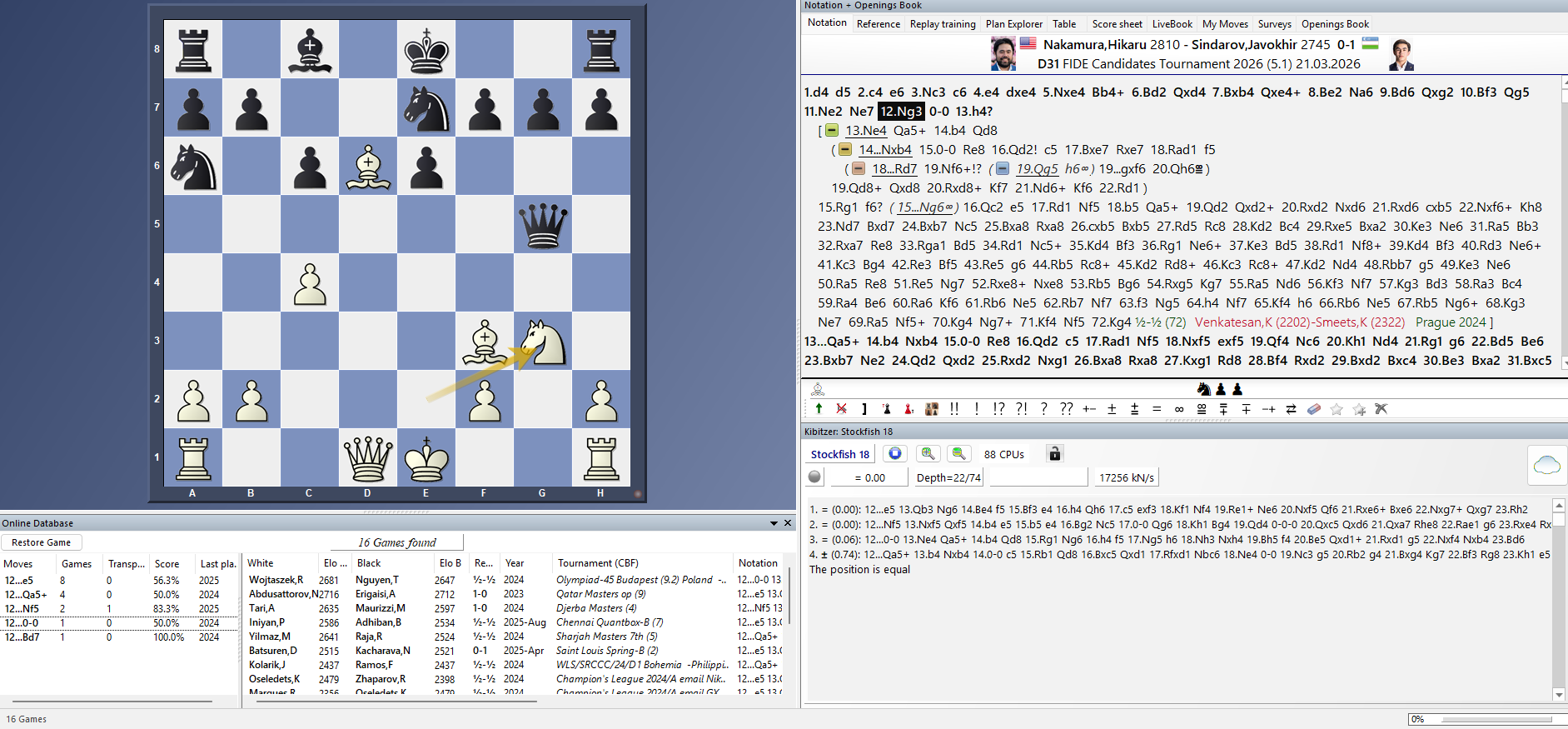
Sindarov played 12…O-O. Nakamura then thought for about one hour and seven minutes before choosing 13.h4, which was inaccurate. The more resilient move was 13.Ne4. Sindarov won the game and moved to 4.5/5.
The important point is not that castling was the engine’s first choice. It was not. In the analysis screenshot I posted after the game, 12…O-O appeared as the third engine line, with an equal evaluation at that search depth. It had also appeared in a previous database game. More importantly, it is an obvious human candidate. Black’s king is in the center, the rook is undeveloped, and castling asks White to justify the sacrificed pawns immediately.
A second can decide that a move is unlikely. That happens all the time. Preparation cannot cover every legal move to move 40. But in a tabiya this sharp, a natural move that appears near the top of the engine list and has already been played cannot simply disappear. At minimum, the file should say what the player is supposed to do against it.
A second is an editor, not an engine operator
Modern engines can generate more analysis than any player can remember. If a team sends all of it, the player is not better prepared. He is buried.
The real work starts with selection. Which opening is the opponent likely to choose? Where will he deviate? Which positions fit our player? Which lines are forcing enough to memorize, and which ones need an explanation instead? If the opponent plays a move we did not prioritize, can our player reconstruct the idea at the board?
A useful preparation file has a hierarchy. It identifies the tabiya, covers the serious candidate moves, marks the tactical points that cannot be improvised, and explains the plans after the forced sequence ends. It also distinguishes between a move that is objectively best and a move that is especially dangerous for this player on this day.
That last part matters. A second is preparing a person, not a machine. One player wants a compact file with two reliable choices. Another wants a broader map. One remembers variations visually. Another remembers the verbal reason behind each move. Good work that is delivered in the wrong form can still fail.
Why Kramnik-Leko still matters
The famous comparison is game eight of the 2004 Kramnik-Leko World Championship match. Vladimir Kramnik allowed Peter Leko’s Marshall Attack and followed deep preparation in a rare line. The first new move was 18…Nf6, and Kramnik continued quickly into a queen sacrifice. After 24.Qxe2 Bxe2 25.bxa6, his analysis had judged that the advanced pawn gave White compensation. Leko found 25…Qd3 over the board, exposing the flaw, and won in 32 moves.
That example came from a different technological period. Engines were already central to preparation, but hardware was weaker and a difficult position could change evaluation after more time or greater depth. Contemporary analysis of the game suggested that the refutation may have been hidden behind a long forced branch among many Marshall lines.
Those old horizon problems have become much rarer, but it would be too absolute to say that engines can no longer mislead anyone. Engines, hardware, settings, and positions still matter. The bigger modern danger, however, is usually not that the machine failed to see a move. It is that the team did not ask the right question, did not inspect a natural candidate, or did not communicate the answer clearly.
What accountability should look like
The player always has final responsibility. He chooses the opening, hires the team, plays the moves, and can reject the file. Nakamura later acknowledged his own share of the blame. That does not mean the seconds have no responsibility. If a team is hired to prepare a sharp line for the Candidates and misses a move such as 12…O-O, the work failed at an important point.
I understand why Nakamura spoke publicly. He had to explain why he spent more than an hour on move 13 after playing a prepared pawn sacrifice. There was also a psychological shock. You choose your sharpest weapon, expect to surprise the tournament leader, and discover on move 12 that your map has a hole. Now you must solve a complicated position while also processing the fact that your preparation has ended.
His reaction may have been harsher than necessary. Team disputes are usually better handled privately. But the chess criticism itself was not unreasonable.
The invisible standard
The best seconds are rarely noticed. Their player reaches a critical position, recognizes the main branches, understands the ideas, and begins the real game with time on the clock. Spectators see a smooth opening. They do not see the candidate-move checks, database searches, engine verification, opponent modeling, rehearsal, and editing that made it possible.
That is what elite seconds actually do. They do not promise omniscience. They reduce avoidable surprises. In a quiet position, missing the fourth engine choice may not matter. In a prepared pawn sacrifice at the Candidates, missing a natural castling move can decide the day.